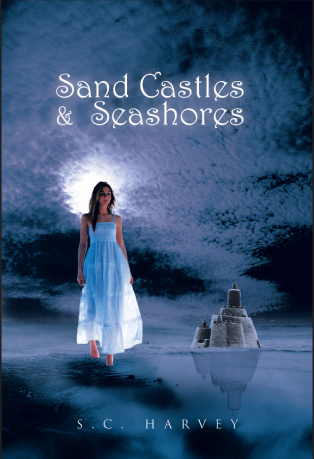
I caught up with friend and fellow author, S.C. Harvey, this week to ask her a few questions about her debut sci-fi action-adventure novel, Sand Castles & Seashores. It's the first in a series of four following the epic journey of Madison Chase as she searches for her true identity. You can read a sample and buy the book over at Amazon . And read to the end for a short excerpt right here. Let's find out more about Madison's, and Harvey's, journey!
So tell us a little about your book, Sand Castles & Seashores.
Sand Castles & Seashores is a story about a young tracker named Madison whose past is hidden from her, and because of her special abilities, becomes the special interest of an agency. Sand Castles is the bleeding of worlds, not so much blending, with elements of two worlds bleeding into each other. It is the turning of the clock backwards and forwards. It is the journey of one woman to find the secrets of her past and fulfill the promise she made years ago. Along that journey, she encounters a special operative named Will Matthews and Nicholas, a special person from her past, and the trio’s lives become intertwined, weaving each into the other’s destinies.
What inspired you to write this story?
My husband began writing and the joy he had was infectious. It renewed my love of writing so I began to pick up the pen again with stories I have long hung onto. Sand Castles & Seashores first came to life in a dream I had long ago. Not that dreams always make sense but there were elements of it that really struck a chord with me, and so I tried to pen what would be understood to the waking public. My hope is that the essence of the story survived the translation from the dreamscape to paper. I wanted the betrayal to have as large an impact as it did and I wanted the rebuilding of her soul to be as compelling a journey as it felt. The characters and their stories are all magnificent and it was up to me to get it down on paper.
How did you get the idea for Madison's 'gift'?
I tried to see what she needed and what would suit her. Madison’s gifts complement her personality. There exists a dichotomy with Madison’s character. Her control over matter makes up for her lack of control over her own life and relationships which she so desperately yearns for. It will be later revealed in the series that she is among a special group of her kind, capable of performing the feats she does, but the talents generally appear later in their lifespan when their thinking ability and minds become more powerful. In Madison’s case, because of her amnesia, her mind was unrestrained, free of the history written for her and was able to realize its unbounded potential. Her powers manifest as she needs them to in order to survive the new reality she found herself in, our world.
What is your favorite scene?
That’s a tough one because there were so many scenes I enjoyed writing. One that stands out for me was when Will showed up at her flat and his true intentions were revealed. I can’t go into it anymore without giving away half of the story but its impact is everlasting on Madison’s character. Another one of my favorite scenes is when Nicholas showed up on the beach. Just his presence spoke volumes as to his role in Madison’s life. And certainly, I cannot leave out the last scene. I had struggled as to how I would end this chapter of her life and funny enough, I slept and had a dream about what it was like her last day with Nicholas before she had to say good-bye to the world she knew. And tah-dah! It brought the story full circle for me and hopefully readers will get that same sense of renewal and finality. She started in the book tracking fugitives and in the end, she is the one hunted.
What books, movies, TV shows, etc. have influenced your writing?
X-Men. Need I say more? I sometimes wonder if I was one of them, what my mutant powers would be. Yes, plural. I mean, don’t we all? And I tinker with the idea; sure the powers are great but what’s messed up with the person because of it or augmented by it?
Truly, there were a lot of shows and movies that influenced my writing because they have influenced me. I am a firm believer in love transcending time and space, that love conquers all, and so the reader will see some struggles along the way before they see a happy ending or the ending most true to the characters. I grew up on shows such as Star Trek TNG, Sailor Moon, MacGyver and Stargate SG-1. I love Hayao Miyazaki works and really admire how he blends worlds together coherently and how his characters are largely simple but beautifully portrayed. Stargate does much of the same but has the element of sci-fi which I find very intelligent and witty. Star Trek and Star Wars helped me to create one of my favorite characters for the Casala Series as well as a feel for the interstellar adventure Casala and Brandon are set on. I love all things spy related - James Bond, Mi-5, Salt and the novel Ice Storm by Anne Stuart. And through this genre, the element of mystery and different sides trying to outdo the other with competent operatives comes to the fore which all makes for a good story for me.
What's next for you?
There are a number of side projects that I am currently working on between series, but the book that is of primary concern is the next book in the Sand Castles series, Galatea Rising – The Shepherd Moon’s Call. It’s the next chapter in the lives of Madison, Nicholas and Will but at the same time a continuation of some of the themes of the first story and incorporating new challenges. I had considered the Prodigal Daughter as a title but it didn’t speak enough to the role Madison must play throughout the series and the destiny she must fight for. Galatea is the shepherd moon for Neptune and influences the tidal activity for the planet, so too will Madison play a central role in the future of Thylea. Even though all the books of the Sand Castles series have already been written, I am working on adding a couple of additional chapters to give more flesh to some of the characters, and after that … Editing.
Excerpt from Sand Castles & Seashores
The cool tide swept in, partially claiming my still, limp body, making every sense vividly raw. My physical wounds have healed over into scars. The not so physical one remained open, but bled no more, because there was nothing left to bleed. The winter that was my soul had frozen into a timeless tundra. Cracks and crevices remained, because in a climate so cold, nothing was left to bind them shut.
There were a few times when I would try to heal myself, to take away the scars, but couldn’t, and more pain ensued. They were a constant reminder of them, of him, of the life that could not be. There were a lot of things I didn’t know about my powers, about myself. Stupid locked box, why can’t I remember?
I remained in this purgatory and lost track of time itself. The concept seemed irrelevant now. There were no deadlines, no jobs, nobody, nothing to tie me to this world ruled by time.
The following day, when I began sculpting a new castle to replace the one taken away during the course of the night, my heart thumped. It wasn’t an ordinary thump that generally went unnoticed, but a powerful beat that became a rhythm responding to something, and it kept pounding. I consciously sensed it shortly after I sensed a shift in the world, a shift in gravity. There was someone coming, whose power rivaled my own, whose very existence validated my own. I shot my gaze up off the sand castle to the cliffs above. A lone figure stood, still in the warm sea breeze that swept through. The winds howled and picked up in intensity against the cliffs, against him, but he would not yield. Against the bright midday sun behind him, my eyes squinted, but I did not turn away. My center shifted, followed by louder thumps from my chest, and I was forced to look away when I felt my hands pulse. I looked down at them, palms raised up to my face, then turned and examining every inch as if looking at them for the very first time. Did he trigger them? I looked back up to where he stood, but he was gone.
I was not able to make out very much from the few seconds that passed. His figure seemed toned but not feeble. His golden blond hair shined with the intensity of the sun. It was short and untamed in the wind. He stood with an air of nobility that seemed out of place from the common man these days, whose postures were never good enough to hide the slouch that ached to come out. I was not able to make out his eyes, or the look upon his face. His clothes were ordinary and casual but seemed to clash with his stance. I sat there for some time, frozen as I thought about him. Ultimately, I decided to try and shake it off, returning my focus to the castle as Tantalus to his boulder.
***
Thanks to S.C. Harvey for joining us today! What new authors have you come across lately?


 by Maureen Ash, part of the Templar Knight mystery series. As you may have already guessed, it's a medieval murder mystery set in Lincoln, England, in the year 1200. I chose it mostly for the setting. As you may know, I love medieval mysteries and I especially like anything from that particular time period. It's the age of Robin Hood, and my favorite era.
 Official Description: